For decades, the advisory world has become increasingly sophisticated at helping families preserve financial capital.
Family business advisors, lawyers, governance specialists and private wealth professionals now guide families through extraordinarily complex questions around succession, stewardship and intergenerational transition.
Structures are built. Governance frameworks are refined. Risk is mitigated. Wealth transfer is carefully planned.
Yet despite this sophistication, one critical form of capital often remains underprotected:
Narrative capital.
The lived stories, philosophies and emotional context that explain not simply what a family built - but why.
Because while financial structures can preserve assets, they do not necessarily preserve meaning.
And in family businesses, meaning matters.
The invisible layer beneath every family business
Beneath most enduring family enterprises sits an invisible narrative architecture.
A founder story. A migration story. A defining sacrifice. A philosophy around employees. A belief about money. A value forged under pressure.
These stories quietly shape culture for decades.
They influence decision-making, frame identity and help younger generations understand not only how wealth was created, but what it was for.
The challenge is that these narratives are rarely captured intentionally.
Instead, they live informally - in conversations, assumptions, anecdotes and memory.
And eventually, they begin to disappear.
What can be lost in transition
Advisors working with family businesses often operate close to moments of profound transition.
A founder exits. Leadership changes. Ownership transfers. The next generation steps forward.
These moments are usually approached through legal, structural and financial lenses.
But beneath the visible transition sits another, quieter transition:
The transfer of narrative.
Will future generations understand the founder’s mindset? Will they understand the emotional history behind the business? Will they understand the values that shaped key decisions?
Or will they inherit assets without inheriting context?
Increasingly, I believe this is one of the most under-discussed challenges in modern family enterprise.
Because continuity is not purely structural.
It is also cultural. Relational. Narrative.
Why narrative loss matters
Families rarely fracture because a spreadsheet was inaccurate.
More often, fracture emerges through differing interpretations of:
legacy
founder intent
identity
fairness
purpose
what the business fundamentally represents
When narrative disappears, interpretation fills the vacuum.
And over time, that can erode shared identity across generations.
The emergence of narrative preservation
Globally, enterprising families are beginning to ask:
How do we transfer wisdom, not just wealth?
How do we preserve founder philosophy?
How do younger generations emotionally connect to the family enterprise?
How do we retain continuity of identity through transition?
These are not purely legal or financial questions.
They are narrative questions.
And they are creating space for a new category of work sitting alongside traditional advisory services: narrative preservation.
Why film changes the equation
Written histories remain valuable.
But filmed storytelling captures something uniquely human:
voice
humour
emotion
pauses
personality
interpersonal dynamics
Future generations do not simply read about a founder.
They encounter them.
And in many families, that emotional connection becomes one of the most meaningful legacy assets they own.
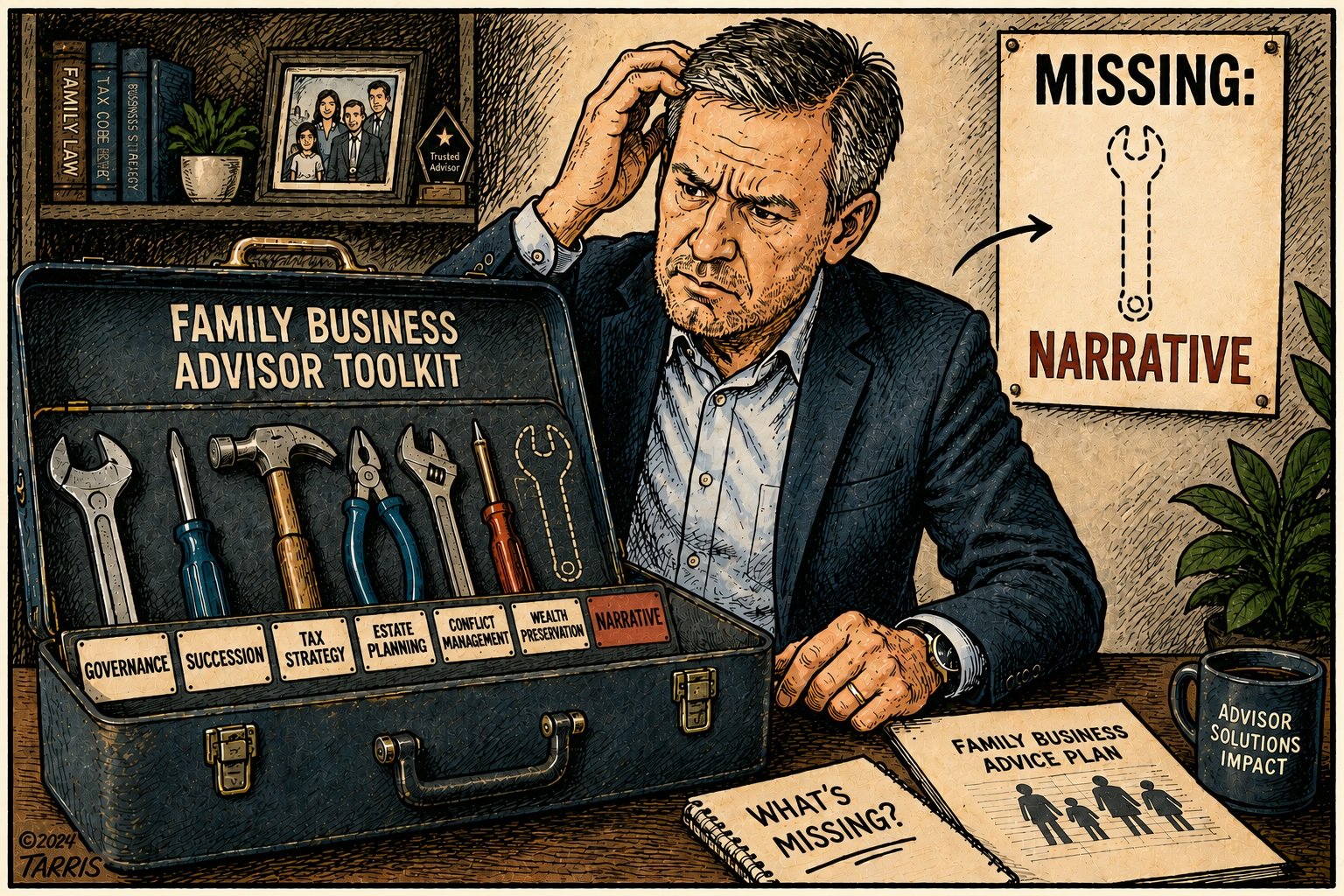
The missing tool
Most advisors already possess sophisticated tools for preserving financial continuity.
But fewer possess tools for preserving narrative continuity.
Yet perhaps both matter.
Because the greatest threat to many family enterprises is not necessarily the loss of wealth.
It is the gradual erosion of shared identity, founder philosophy and intergenerational understanding.
Narrative work cannot replace governance. Nor should it.
But increasingly, I believe it belongs alongside it.
Because families do not inherit businesses through structures alone.
They inherit them through stories.
This is one of the themes I’ll be exploring in my upcoming presentation, Capturing Legacy on Film, to the Advisor Program at the Family Business Association, looking at the role narrative preservation may increasingly play alongside traditional family business advisory services.